What is actually being evaluated in an underwater tunnel project?
It is tempting to treat a tunnel as a material purchase: choose acrylic, confirm a thickness, order curved panels. In practice, the material is the most predictable part of the scope. Cast acrylic behaves consistently; what varies — and what determines whether the project goes smoothly — is everything around it.
A serious tunnel review looks at the system:
- Dimensions and geometry. Tunnel length, cross-section, curvature, and how the run divides into segments.
- Water depth. The governing load input — but an input, not the answer.
- Support and boundary conditions. What the panels sit on, what restrains them, and how loads pass into the structure.
- Joints. Where segments meet, and how those positions relate to the support structure behind them.
- Interfaces. Acrylic to concrete, acrylic to steel, and the waterproofing details between them.
- Construction tolerances. What the civil works will actually achieve, and who owns the difference.
- Installation sequence. Access, lifting, placement order, and how the tunnel scope coordinates with the trades around it.
A supplier who talks only about acrylic grades and thickness is describing a panel. A supplier who asks about the items above is describing a tunnel.
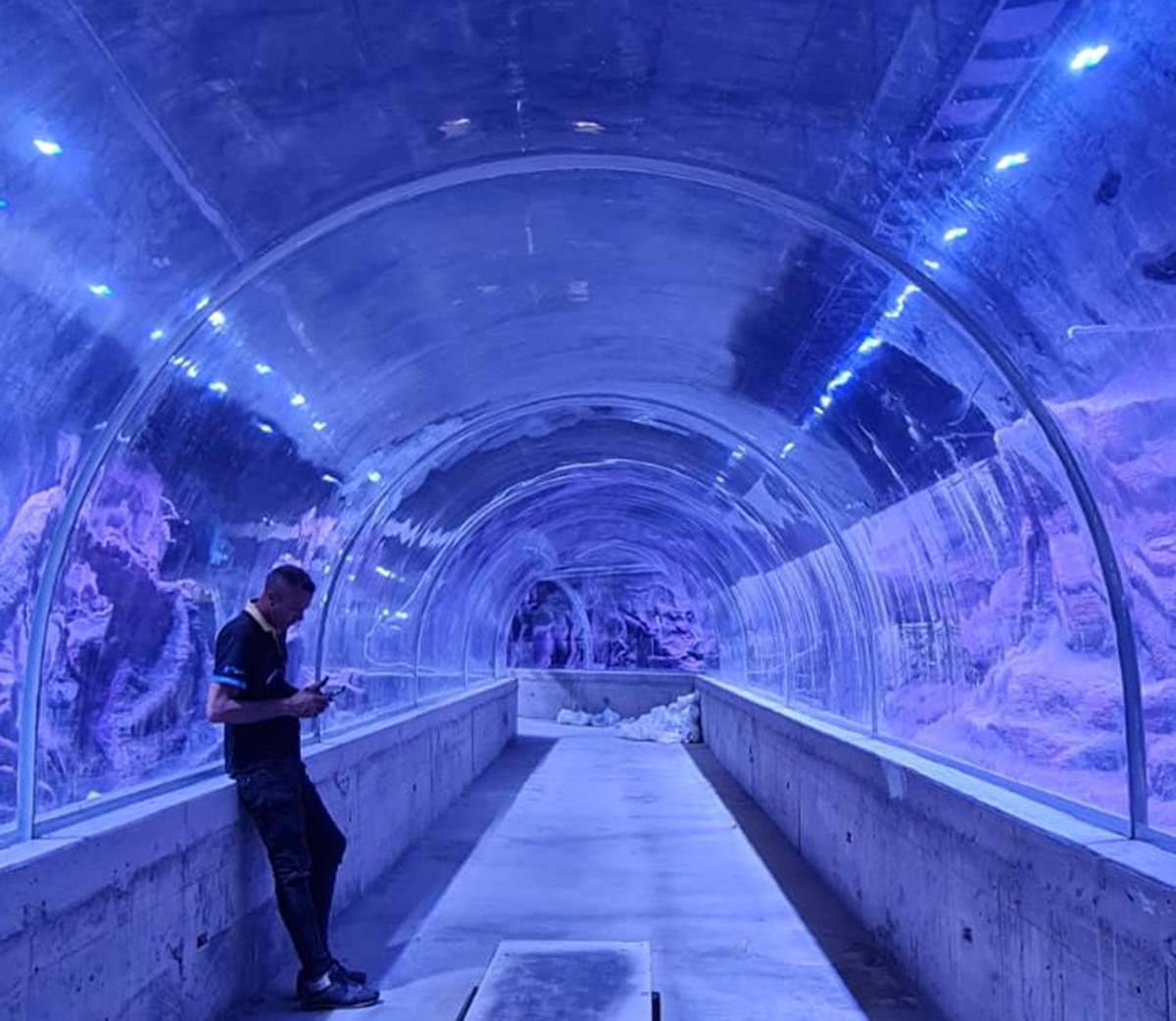
Why tunnel geometry and boundaries matter
A flat viewing panel spans an opening. A tunnel wraps around the visitor, which changes the review in several ways.
Curved geometry means each segment is formed to a defined radius and arc, and small geometric decisions ripple through the whole run: segment length affects handling and transport; curvature affects forming; joint positions affect both the structure and the visitor's sightline. These choices cannot be made panel-by-panel — they are made once, for the whole tunnel, before fabrication.
Boundary conditions matter just as much. The same acrylic section behaves differently depending on how it is supported — continuously along its edges, at discrete points, or restrained at the base and free at the crown. That is why two tunnels with similar water depths can end up with different panel designs, and why no responsible supplier will confirm a tunnel panel from a cross-section sketch alone.
None of this requires the buyer to resolve the engineering personally. It requires the buyer to check that someone will — before fabrication, not on site.
Interfaces usually create more risk than the material specification
In completed projects, the panel itself is rarely the source of trouble. The interfaces are.
An acrylic tunnel meets its structure at several points, and each one is a coordination task:
- Acrylic to concrete or steel. The recess or frame the panel lands in is built by another trade, to another trade's tolerances. The panel is fabricated to precise dimensions; the structure is not. Someone has to own that difference.
- Setting blocks and bedding. Panels bear on defined points or continuous bedding — grout, neoprene, or engineered setting details — and those details must match what the structural review assumed.
- Waterproofing and sealant. The waterproofing line and the sealant joints around the acrylic must be designed together, not discovered at installation. Where silicone is used, the distinction between a structural joint and an architectural weather seal matters, and it should be explicit in the documentation.
- Cumulative tolerance. Small allowances — in the civil works, the frame, the bedding, the panel — accumulate. Individually acceptable tolerances can stack into an interface that no sealant detail can rescue. Cumulative tolerance is checked on paper, cheaply, or on site, expensively.
The practical lesson: when comparing suppliers, ask how interface responsibilities and tolerances are defined in their scope — not just what acrylic they cast.
Related: common acrylic panel problems — locked in before fabrication →
What the Nautilus 25.8m tunnel demonstrates
Completed projects are the most honest evidence a supplier can offer, provided they are read for the right things.
The walk-through tunnel at Acuario Nautilus in Peru is 25.8 metres of curved cast-PMMA segments — 70mm panels under 800mm of water — and it has been open to the public since 2023. As proof, it demonstrates specific and checkable things: that curved segments were formed, delivered, and installed as a continuous public walk-through; that geometry, joints, and installation sequence were resolved before fabrication; and that the result has been operating in front of visitors, not in a brochure.
It is worth being precise about what a reference like this does not mean. One completed tunnel does not make every tunnel identical — your geometry, depth, and structure will differ, and the review starts fresh. A project reference also says nothing useful if it comes without real numbers; length, thickness, and water depth are what make a reference checkable rather than decorative.
Nautilus is not an isolated case. Our tunnel scope also includes the panels for the 20.4m underwater tunnel in Gdańsk, Poland — fabricated by Forma Fabrica, with the panel supply from our side — and a completed 6.5m walk-through tunnel in India. Different lengths, different structures, different partners: which is exactly the point. Tunnel experience is experience with variation.
What buyers should review before quotation
A tunnel project does not need to be fully designed before talking to a panel supplier. In fact, earlier is better — much of the avoidable cost in tunnel projects comes from geometry and interface decisions made before the panel supplier was consulted.
A useful initial review can begin with three inputs:
- Acrylic dimension — the tunnel's approximate length and cross-section, even if preliminary.
- Water depth — the depth over the tunnel, even as a design intent.
- Drawings, if available — sections or sketches sharpen the review, but their absence does not prevent it.
With these, a supplier can assess the realistic segment approach, flag geometry or interface questions that need answers before fabrication, and indicate what the project review will need to cover. Approximate values are acceptable; the point of an early review is direction, not final numbers.
Everything else — support conditions, tolerances, joint design, waterproofing coordination, lifting and site sequencing — belongs inside the project-specific technical review that follows, where it can be resolved against your actual structure and programme.
What cannot be decided from water depth alone
Water depth is the first number any tunnel review asks for, because it sets the pressure load. It is also the number most often misused.
Depth alone does not determine panel thickness, and it certainly does not determine geometry, support, or joint design. Two tunnels at the same depth can require different panels because their spans, curvature, and boundary conditions differ. For that reason, we don't publish a universal thickness rule — an indicative range can frame early budgeting, but no table replaces the project-specific review that sets the final figure. Real deliveries show the variation: Nautilus used 70mm under 800mm of water; the Gdańsk tunnel used 100mm. Both figures are project outcomes, not templates.
If a supplier hands you a thickness from a depth figure alone, treat it as a marketing number, not an engineering one.
Questions to ask an acrylic tunnel supplier
However the shortlist is built, a few direct questions separate tunnel experience from panel talk:
- Can you show completed tunnel projects — with real numbers? Length, panel thickness, and water depth make a reference checkable.
- What do you need from us to start a review? A supplier with a working process asks for a small, defined set of inputs — and reviews before quoting.
- What does your scope cover beyond casting? Tunnel supply spans panel production, forming, bonding, finishing, packing, and installation coordination. Ask where the supplier's responsibility starts and ends.
- How are interface responsibilities and tolerances defined? Who owns the gap between the civil works and the panels — and where is that written down?
- Are your project claims documented? Named projects, real dimensions, and detail available for technical review are worth more than adjectives.
A supplier comfortable with these questions is describing work they have done. A supplier deflecting them is describing work they hope to do.
Tunnel project review — frequently asked questions
What should a buyer evaluate in an underwater acrylic tunnel project?
The complete system, not just the acrylic: tunnel dimensions and curved geometry, water depth, support and boundary conditions, segment joints, acrylic-to-structure interfaces, construction tolerances, and the installation sequence. The panel material is the most predictable part of the scope; most avoidable risk sits in geometry decisions and interface coordination that must be resolved before fabrication.
How long is the acrylic tunnel at Acuario Nautilus?
The walk-through tunnel at Acuario Nautilus in Peru is 25.8 metres long, built from curved cast-PMMA segments with 70mm panels under 800mm of water. It has been open to the public since 2023. PG Acrylic supplied the tunnel's acrylic panels; the project is a checkable reference because its length, thickness, and depth are published.
Does water depth determine acrylic tunnel panel thickness?
No — water depth sets the pressure load and is the first input any review asks for, but thickness also depends on geometry, spans, and support conditions. Two tunnels at the same depth can need different panels. Completed projects show the variation: 70mm under 800mm of water at Nautilus; 100mm at the 20.4m Gdańsk tunnel. Final figures are always project-specific.
What information does an acrylic tunnel panel review need to start?
Three inputs: the acrylic dimension (approximate tunnel length and cross-section), the water depth, and drawings if available. Approximate values are acceptable — an early review gives direction, flags geometry and interface questions, and defines what the full project review must cover. Support conditions, tolerances, joints, and sequencing are then resolved in the project-specific technical review.
How do you evaluate an acrylic tunnel supplier?
Ask for completed tunnel references with real numbers (length, panel thickness, water depth), a defined review process that starts from few inputs, a clear scope statement — panel production, forming, bonding, finishing, packing, and installation coordination — and written definition of interface responsibilities and tolerances. Documented, named projects are worth more than superlatives.
Reviewing a tunnel project? Start with three inputs
An underwater acrylic tunnel rewards early, systematic review: geometry and segmentation decided once, interfaces and tolerances owned on paper, installation sequenced before fabrication. Completed projects — Nautilus at 25.8m among them — show what that looks like when it works.
For the full tunnel panel supply scope — joints, geometry, and indicative ranges — see our underwater tunnel acrylic panel page. Cast Acrylic (PMMA) Viewing Panels 20–600mm, reviewed project by project.