Acrylic Pool Wall — Cast PMMA Viewing Panels, Design and Interface Planning
Project-specific acrylic pool wall design based on opening size, water depth, supported edges, panel geometry and civil or steel interfaces.
PG Acrylic manufactures and supplies structural cast acrylic (PMMA) viewing panels for pools, aquariums and underwater structures — including the pool viewing walls this note covers. An acrylic pool wall — also called a transparent pool wall, an acrylic pool window, or a swimming pool viewing window — is one of the most visible design decisions on a project, and one of the most misjudged, because thickness is specified from water depth alone and the interface is resolved on site. For a quote, approximate opening width and height, water depth, application, project location, and any drawing you have are enough to get started; if more information is needed, we'll ask.
Manufacturing since 2006 · TÜV / SGS / Bureau Veritas third-party reports
Summary for project owners: on large acrylic pools, leakage and cracking risk is concentrated where the panel meets the concrete — we define that interface for your contractor up front so it is built right the first time.
A rooftop pool in Malaysia — what actually changed the thickness
The client sent us the water depth. That was all.
No span. No frame drawings. No perimeter details.
We asked. The CAD came back a month later. The span was larger than they'd assumed, and the edge condition on site meant the sealing had to be done differently from a standard install.
The required thickness increased once the span and edge condition were known. Not because the water got deeper — because we finally had the full picture.
Water depth tells you the load. Span and edge condition tell you the thickness.
Pool wall performance depends on the interface as much as on the panel.
The panel is the part the client sees. The interface is the part the engineer resolves in a workshop, or the installer resolves on site. These are not the same thing.
What goes wrong
- Thickness from water depth aloneWater depth sets the pressure load. Span and boundary conditions determine how much of that load the panel must resist in bending. Skipping this step is where under-specified panels come from.
- Interface resolved on siteChannel geometry, bearing width, gasket specification, and sealant type collectively govern watertightness. When these are treated as installation details rather than design inputs, leakage risk increases.
- Boundary conditions assumed, not confirmedA panel supported on all four edges behaves very differently from a panel supported on two. The difference translates directly to required thickness — and the assumption is rarely documented.
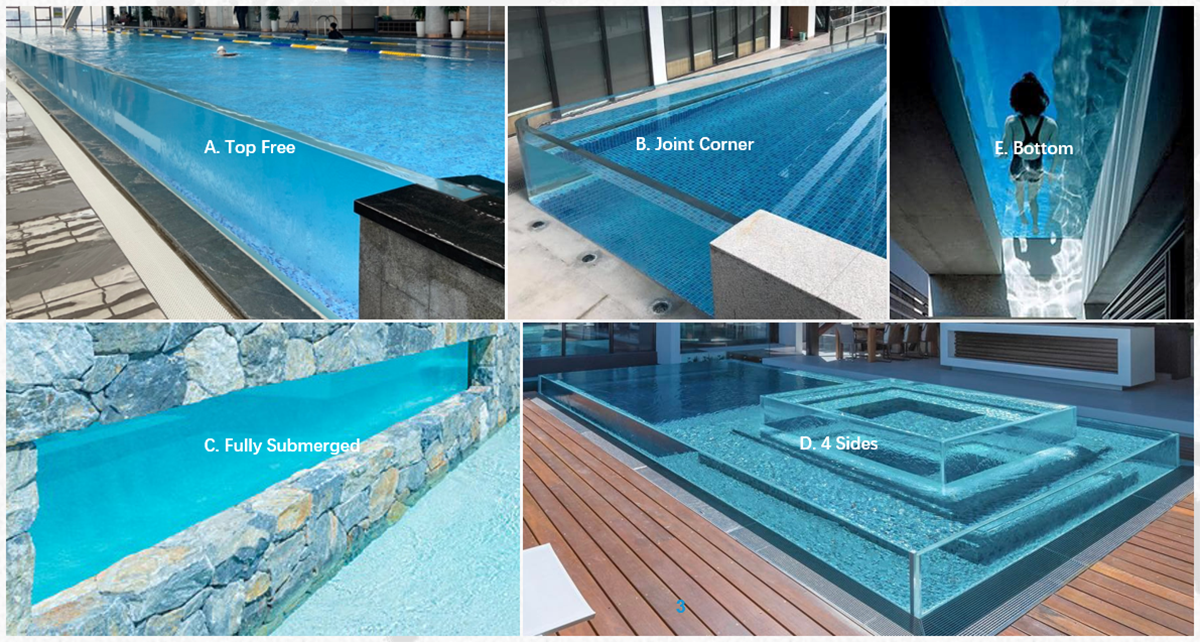
Visible span, water depth and perimeter interface are three inputs that should be confirmed in the initial specification.
Confirm the interface before confirming the thickness.
Panel thickness calculation requires knowing how the panel edges are supported. That means the interface must be resolved before thickness can be finalised — not after.
Channel geometry
Channel depth, width and project-specific panel edge clearance. Channel material and surface tolerance must be confirmed — the panel is machined to fit the channel, not the other way around.
Bearing and gasket
Bearing width on each support edge. Gasket material — EPDM, neoprene, or silicone — compression and whether the gasket is primary seal or secondary. Each choice affects deflection behaviour at the panel edges.
Sealant joint
Sealant type, joint width and depth, bond face preparation, and primer requirements for acrylic and the channel substrate. An incorrect sealant-to-acrylic bond is a frequent interface risk when surface preparation, joint geometry or installation conditions are not controlled.
How acrylic pool wall thickness is determined
Acrylic pool wall thickness is determined from the clear opening width and height, design water depth, supported edges, free-edge conditions, panel geometry, support structure, serviceability criteria and the applicable design basis. Final thickness requires project-specific structural and fabrication review. Hydrostatic pressure increases with water depth, while unsupported span and boundary conditions govern the panel’s bending response. Water depth, span and support conditions must therefore be evaluated together.
| Parameter | What it determines | Common error |
|---|---|---|
| Water depth | Hydrostatic pressure load on the panel face | Used alone to specify thickness — insufficient |
| Visible span | Bending moment demand — increases with span² | Not stated, or confused with opening size |
| Boundary conditions | Edge restraint — 2 or 4 sides, clamped or simply supported | Assumed 4-edge simply supported when frame has partial contact |
| Deflection limit | Maximum mid-panel movement under full load | Not specified — sealant fails when deflection exceeds joint capacity |
| Safety factor | Margin against characteristic PMMA tensile strength | Taken from an unrelated project or not stated |
| Thickness review inputs | |
|---|---|
| Clear opening | Width, height and unsupported span |
| Design water depth | The water level and resulting hydrostatic pressure distribution |
| Supported edges | Two-side, three-side, four-side, bottom-supported or free-top-edge conditions |
| Panel geometry | Flat, curved, corner or other project-specific configuration |
| Supporting structure | Concrete rebate, steel frame or mixed concrete-and-steel support |
| Serviceability criteria | Deflection limits, seal performance and interface movement |
| Design basis | Material data, load cases, allowable criteria and approval requirements |
| Final review | Project-specific structural, interface and fabrication review |
Swimming pool acrylic panels are engineered for the project-specific geometry, water depth, support conditions and required thickness.
Full thickness review methodology — span, boundary conditions and project-specific analysis →
What helps finalize thickness and interface details.
Core inputs for final technical confirmation
- Clear opening width and heightThe visible opening between support edges — including the unsupported span
- Design water depthThe design water level at the panel — pressure increases toward the base of the panel
- Supported sidesTwo, three or four sides, bottom-supported — including any free or infinity edge
- Support structureConcrete, steel or mixed concrete-and-steel — affects channel geometry feasibility
- Cross-section drawing or project sketchEven sketch-level drawings clarify span and boundary assumptions faster than description
Useful to include
- Supplier scopeFor an acrylic pool wall, confirm whether the scope is panel supply only, or panel plus interface and installation coordination.
- Channel or slot detailsDepth, width, material, surface preparation — if already designed
- Deflection toleranceAny limit from the structure or sealant specification
- Programme constraintsDelivery windows, installation sequencing, commissioning dates
Completed pool viewing wall projects
The following photographs are from completed projects. Each shows a different aspect of the engineering and installation condition — not product presentation.
Other completed acrylic pool-wall projects include Diana Dea in Réunion and Crystal Blue in the Philippines. Velero, Qatar, 2024 — the acrylic pool viewing-wall system at Velero Doha has a total length of 10.6 m and a height of 1.0 m, using 100 mm cast PMMA for that project's geometry and support conditions. PG Acrylic supplied and installed the acrylic panels. View the Velero project →
Maximum single-panel size without joints: 8.7 m × 3.0 m. For projects requiring longer continuous viewing walls, multi-panel systems with on-site polymerization bonding can be reviewed based on the project geometry and installation conditions — as on the 48.24 m Vietnam wall below. A private-villa project in Myanmar provides another multi-panel reference: a 26.2 m total transparent wall system formed from three 100 mm panels joined using on-site polymerization bonding. View the Myanmar residential pool wall case → PG Acrylic can also manufacture custom curved cast acrylic viewing panels; a completed curved pool viewing wall in the Dominican Republic — 6.35 m long × 1.8 m high, 100 mm cast PMMA — was supplied by PG Acrylic.
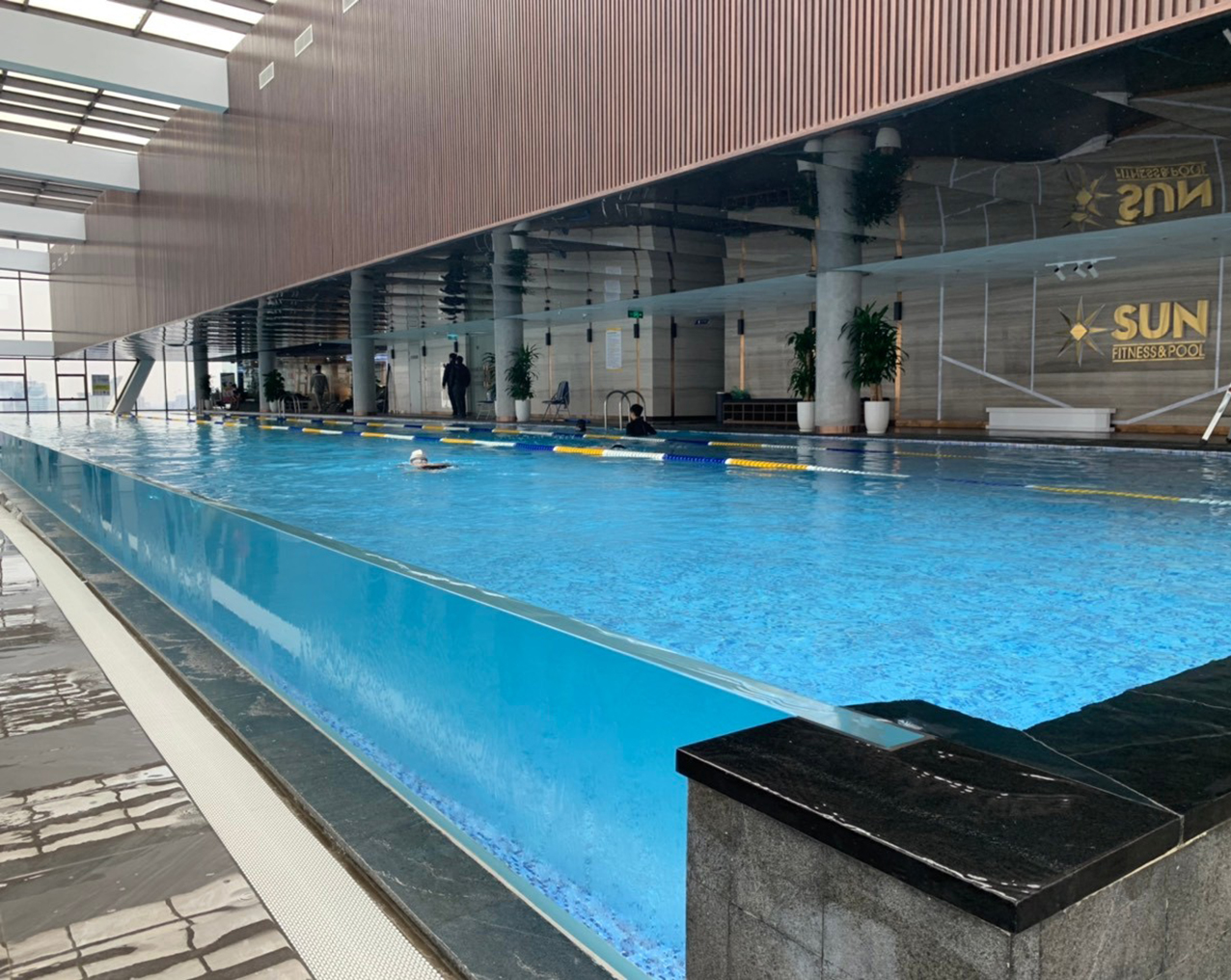
Public gym, Vietnam — acrylic pool-wall system with a total length of 48.24 m (the total system length, not a single panel), formed by five acrylic panels polymerization-bonded on site by PG Acrylic. Full panel height and water depth visible from exterior. View the full Vietnam project case →
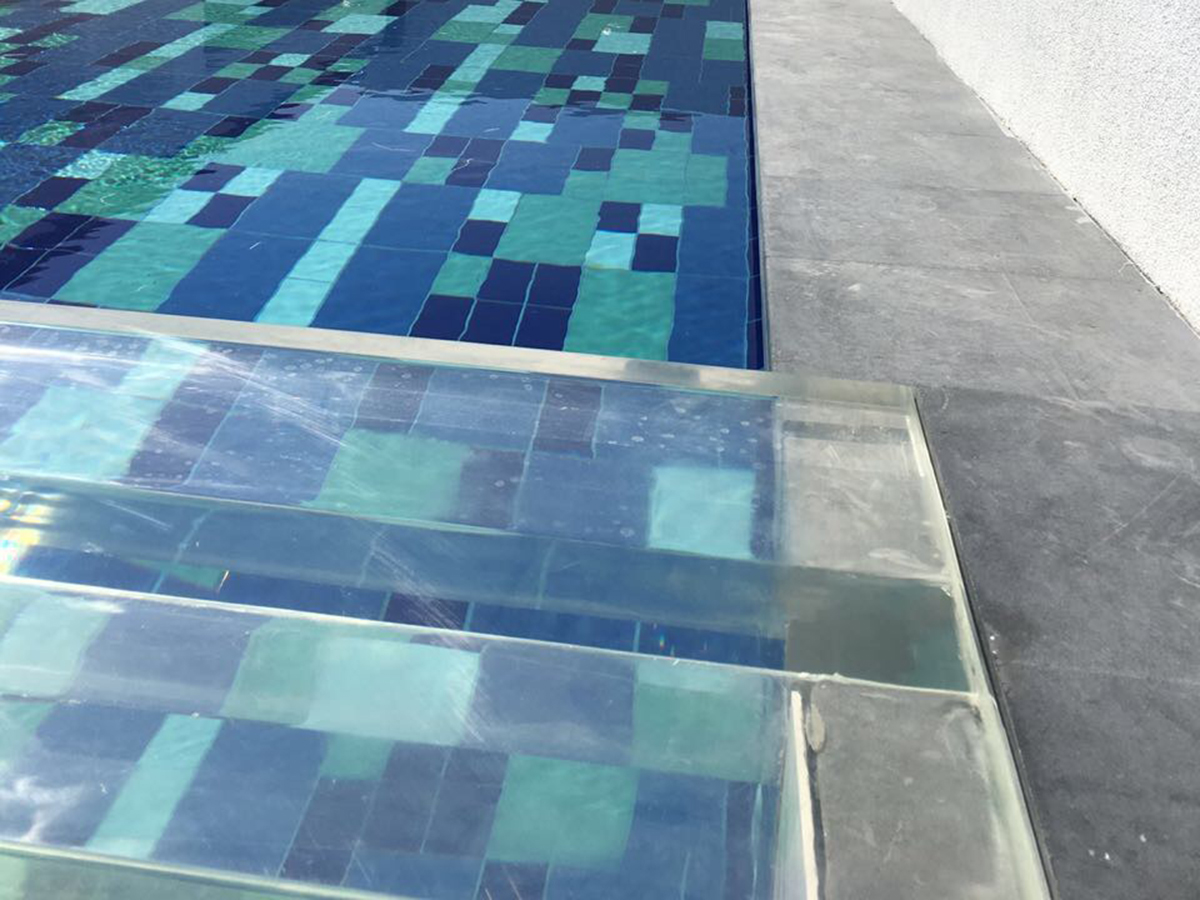
Acrylic pool viewing window, Dubai, UAE. Panel top edge at the junction with the deck.
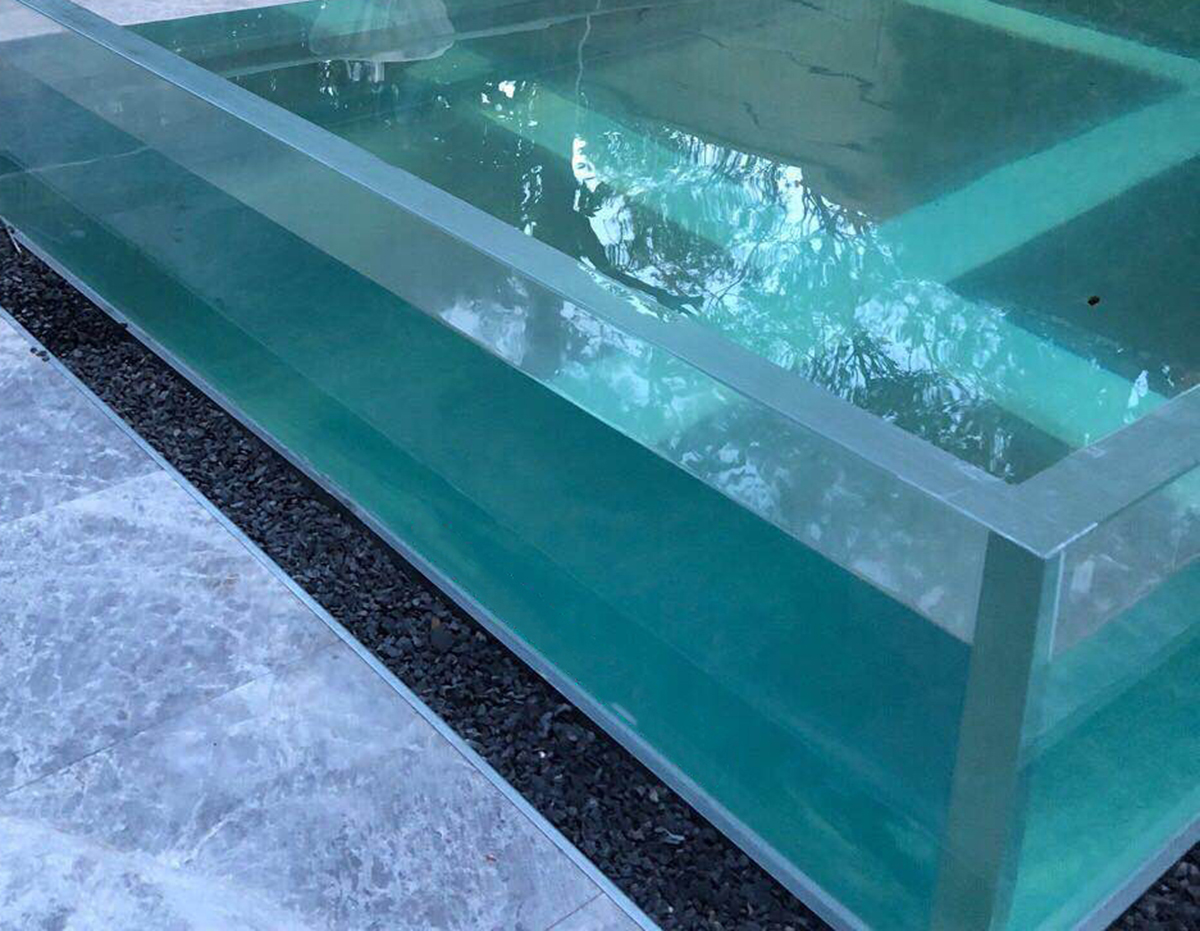
Freestanding transparent pool. Four-sided panel construction — corner joints, cast panel thickness, and base support condition all readable.
Pool viewing wall — questions that come up on every project
How is pool window thickness determined for an acrylic pool viewing wall?
Acrylic pool wall thickness is determined project by project from the clear opening size, design water depth, supported edges, any free-edge condition, panel geometry, support structure, serviceability criteria and the applicable design basis. Final thickness requires project-specific structural and fabrication review. A thickness used on one completed project should not be treated as a general recommendation for another pool.
Why do pool acrylic panels fail?
Water depth defines the hydrostatic pressure acting on the panel, while unsupported span and boundary conditions govern its bending response. Increasing either the load or the unsupported span can increase the required thickness. Final thickness must therefore be based on the complete geometry, support condition, serviceability criteria and design basis.
What interface details are needed before fabricating a pool viewing panel?
Four items must be confirmed: channel geometry (depth, width, and panel edge clearance), bearing and gasket specification (EPDM, neoprene, or silicone — including compression and whether it is primary or secondary seal), sealant type with joint width and depth, and the surface preparation and primer requirements for both the acrylic and the channel substrate. Interface details resolved on site rather than in design are a recurring source of rework when the interface is not resolved early.
What is visible span and why must it be reviewed with water depth?
Visible span is the largest unsupported panel dimension between support edges. It is not always the same as the architectural opening because the channel or rebate may provide bearing width. Water depth defines hydrostatic pressure, while visible span and boundary conditions govern the panel’s bending response. All three inputs must be reviewed together when determining thickness.
When is this decision ready for technical evaluation?
When the project has confirmed opening dimensions, water depth, which edges are supported, and what the channel or frame interface looks like. If any of these are still open, use this note to close them first — then submit.
What should an EPC contractor confirm about the concrete interface before installing a large acrylic pool wall?
The panel-to-concrete interface is a critical design and coordination area on large acrylic pool walls. Before production, PG Acrylic issues a recess (slot) drawing specifying the recess profile (U- or L-shaped) and its width, depth and length for the project; the concrete recess must be built to that drawing. Panels are then set into the recess — for very long walls, bonded on site into one continuous wall first, as on the 48.24 m continuous transparent pool wall in Vietnam.
Comparing acrylic and glass for a pool viewing wall? See the material, structural and installation differences →
Related notes
Corner installations — joint preparation before placement
Corner installations need a project-specific joint detail. Cracking risk can concentrate where two pieces meet if the joint geometry or surface preparation is incomplete.
The treatment exists. It's not complicated. But it has to be done before the panel goes in, not after the water is running. Corner cracking can result when the required preparation step is omitted or not communicated before installation.
We include corner preparation requirements in the installation guidance. It's easier to prevent than to fix.
Interface Coordination & Risk Mitigation: the Vietnam 48.24 m Transparent Pool Wall
On large acrylic pool walls, the panel-to-concrete interface is a critical structural and waterproofing coordination point. Before panel production, PG Acrylic issues a recess (slot) drawing to the client and requires the concrete recess to be built to it — defining the recess profile (for example U-shaped or L-shaped) with the width, depth and length set per project. On the Vietnam public-gym project, the five acrylic panels were polymerization-bonded on site by PG Acrylic into one continuous transparent pool wall with a total length of 48.24 m, then set into the recess together. Defining the civil interface before installation clarifies responsibilities and reduces gaps between panel supply, structural work and site installation. View the full Vietnam project case →
Panel deflection, corner cracking, and installation mistakes
Recurring problems on pool and aquarium projects include under-specified thickness, incomplete corner-joint preparation and protective film removed too early. The Common Problems guide explains these failure modes and the project inputs used to reduce their risk.
Read: Common Problems — what goes wrong and whySpecification approach and what we need from you.
Thickness
Project-specific
Acrylic pool wall panels are engineered for the project-specific geometry, water depth, support conditions and required thickness.
What to send us
These inputs are used to confirm project-specific thickness. Without them, any final thickness figure would be incomplete.
- Clear opening width and height
- Design water depth
- Supported sides — including any free or infinity edge
- Concrete, steel or mixed support structure
- Cross-section drawing or project sketch
- Required supply and installation scope (optional)
Need a quote for your pool project?
Send your approximate opening size, water depth, project location, and any drawing you have. If more information is needed, we'll ask.
Complex project? Technical review is available when needed.