Oceanarium Acrylic Panels —
Cast PMMA Manufacturing, Bonded Construction and Structural Review
Structural cast acrylic (PMMA) viewing panels for oceanariums and large public aquariums — supplier scope, large-panel capability, and the review package that carries sign-off.
PG Acrylic manufactures and supplies structural cast acrylic (PMMA) viewing panels for oceanarium and large public-aquarium projects — cast from 20 mm to 600 mm thick, with single panels up to 8.7 m × 3.0 m without joints and bonded multi-panel construction for larger oceanarium acrylic windows. At this scale the review package matters as much as the panel: fabrication evidence, structural calculations, material certification and third-party review collectively define acceptance — this page covers both.
Manufacturing since 2006 · TÜV / SGS / Bureau Veritas third-party reports
For a project-specific review, send clear opening dimensions, tank water depth, panel geometry, support condition, drawings and schedule.
Named projects behind this page.
TU Delft research aquarium — Netherlands
All-acrylic cylindrical research aquarium, 3 m diameter × 3 m high in 100 mm cast PMMA, with a polymerization-bonded base — supplied by PG Acrylic. The same seamless bonding discipline is applied at oceanarium scale.
Casino aquarium — Macau
PG delivered large-format viewing panels at 150 mm for 2.5 m water depth.
More completed work across aquarium, pool and tunnel applications: Installed projects →
Material and quality documentation for oceanarium-grade PMMA.
Oceanarium projects require a complete evidence package before structural sign-off. These certifications and test reports are available for download to support your engineering review process.
Summary for project owners: at oceanarium scale, the engineering and evidence package matters as much as the oceanarium viewing panel — we provide both so sign-off and delivery go smoothly.
The calculation package is usually requested at the wrong moment
Two weeks before production starts is already urgent at this scale.
The fabrication cycle for a large oceanarium panel is long. The structural review involves bonded assembly calculations, not just raw sheet certifications. And the format required by the structural engineer's reviewer is rarely the same as what was initially prepared.
Changes requested two weeks before production — at this project scale — are already in urgent territory.
We start the documentation package early, before anyone asks for it.
What makes oceanarium panels different from every other application type.
For giant aquarium acrylic panels, thickness is only one part of the design. Very high pressure, large span, bonded multi-piece construction and public-use requirements must also be considered.
Pressure — 8–16m of water above the panel
Full-scale oceanarium tanks are typically 8–14m deep. The hydrostatic pressure at panel centroid is 3–5 times that of a typical hotel pool wall — and the safety factor applied is also higher.
Span — 6–14m of unsupported PMMA
Oceanarium windows routinely span 6–14m or more. At this span, bending demand is the governing structural constraint. Span is why bonded construction is usually required regardless of thickness.
Consequence — public occupancy at scale
Thousands of visitors per day stand in front of these panels. The safety factor, evidence requirements, and review process all reflect the consequence of failure — not just the structural load calculation.
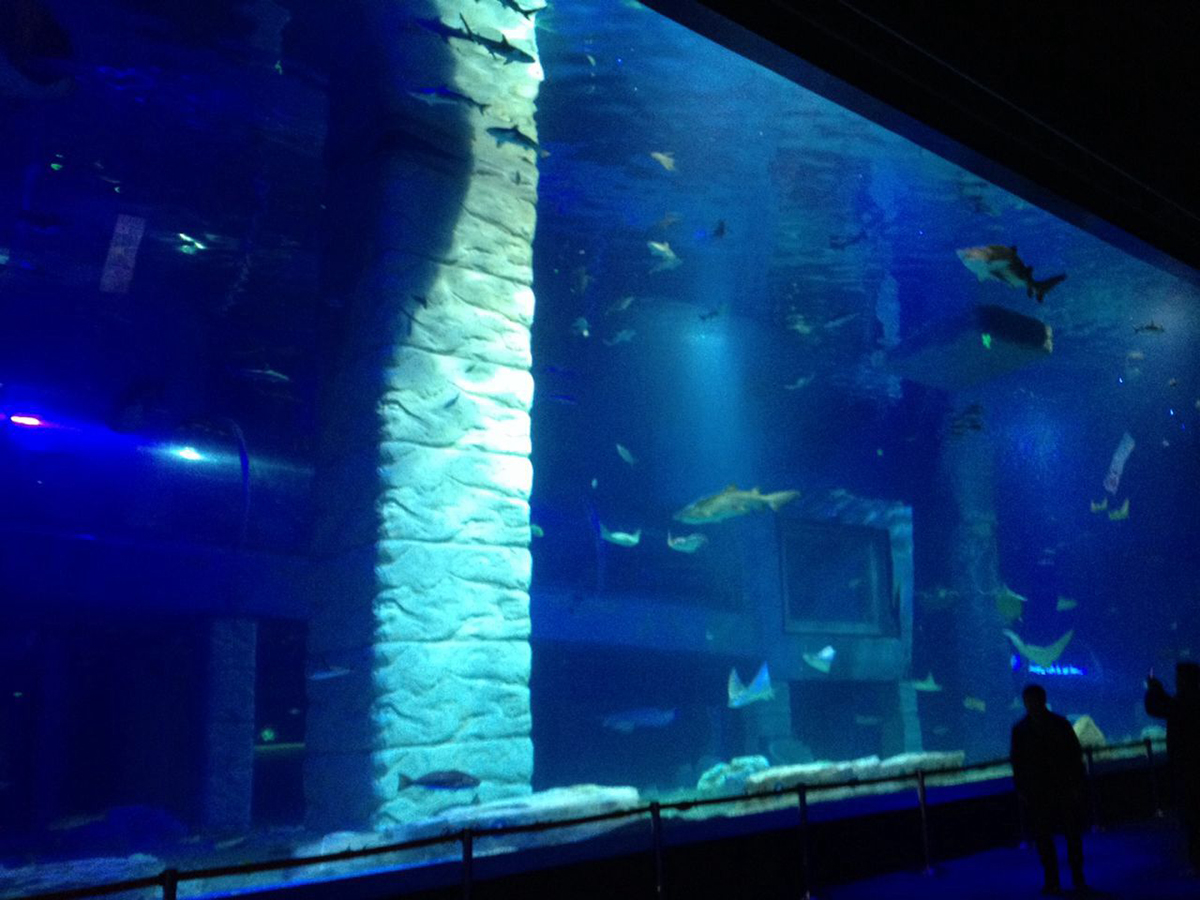
What the review package contains — and why each item exists.
Each document answers a specific question the owner, engineer, or authority having jurisdiction will ask. Scope the package before procurement — not after fabrication.
Structural calculations
- Panel and bond joint analysis — FEA or analytical
- Safety factor justification against project specification
- Deflection check under design load
- Third-party peer review if required
Material certification
- Cast PMMA certificate — MFR, density, tensile properties
- Batch traceability from casting to finished panel
- Annealing cycle records
- Sample retention for reference testing
Fabrication inspection
- Dimensional inspection records
- Visual inspection against agreed acceptance criteria
- Bond joint inspection and test records
- Surface quality and optical distortion assessment
Handover package
- Panel identification and numbering plan
- As-built records
- Installation instruction and confirmed sequence
- Maintenance and inspection guidance
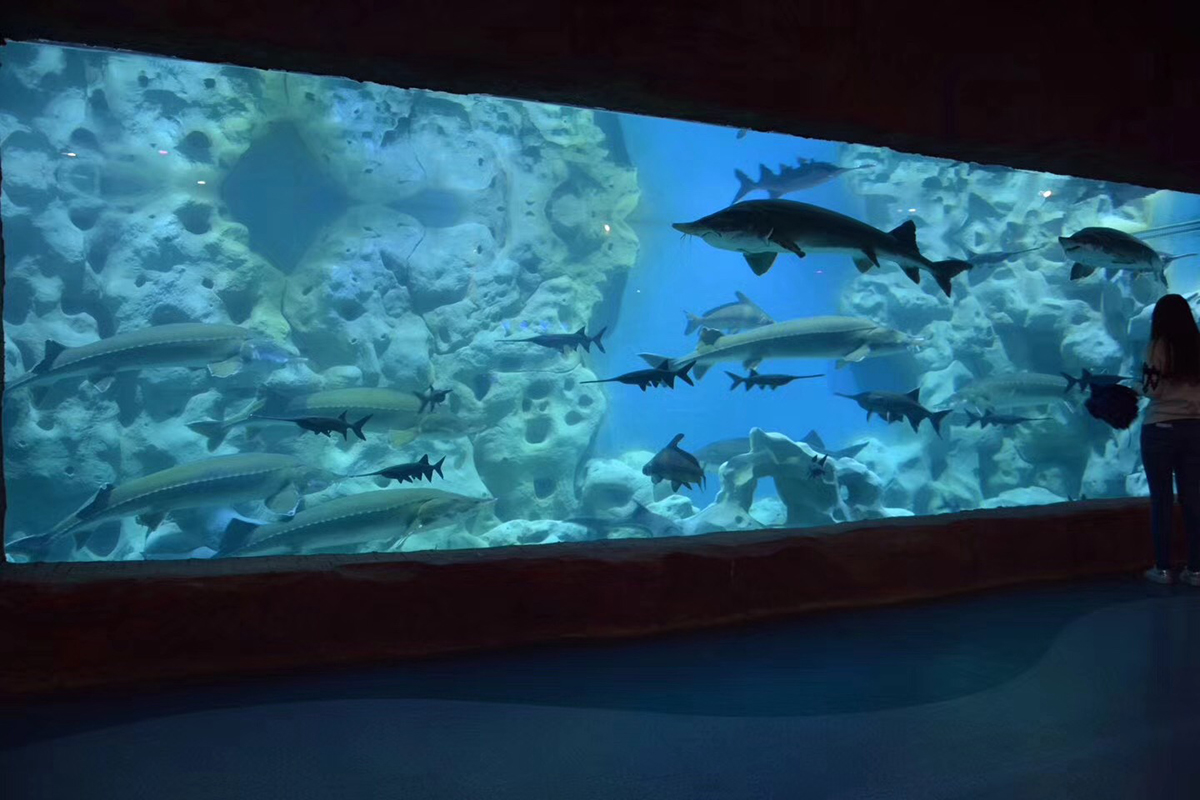
Why most oceanarium windows are bonded — and what that adds to the scope.
Single-piece cast PMMA panels are limited by maximum dimensions achievable from the casting and annealing process. At oceanarium spans, bonded multi-piece construction is usually the only option. Bonding is not a fabrication convenience — it is a structural joint that must be designed and verified.
The all-acrylic research aquarium supplied by PG for TU Delft (Netherlands) — a 3 m × 3 m cylinder in 100 mm cast PMMA — uses a polymerization-bonded base: the same seamless bonding discipline applied at oceanarium scale.
Bond joint design
Joint width, overlap length, adhesive specification, and surface preparation are structural inputs. The bond joint analysis must be included in the structural calculations — not appended as a footnote after the panel analysis is complete.
Curing conditions
Structural acrylic adhesive requires controlled temperature, humidity, and UV protection during cure. Protection from mechanical disturbance must also be maintained. Curing conditions must be documented — not assumed from the adhesive manufacturer's general guidance.
Quality assurance
Bond joints must be inspected before the bonded assembly leaves the factory. After installation, the joint is inaccessible. Non-destructive inspection methods and acceptance criteria must be agreed before bonding begins — not after a questionable joint is already in the tank.
Indicative thickness at oceanarium scale.
| Application | Typical span | Tank depth | Indicative thickness |
|---|---|---|---|
| Large public aquarium viewing window — feature | 4–6m | 6–10m | 250–350mm |
| Oceanarium — mid-scale | 6–9m | 8–12m | 320–450mm |
| Oceanarium — large | 9–14m | 10–14m | 400–550mm |
| Mega oceanarium panel | 12m+ | 10–16m | 500–600mm |
Indicative only. Oceanarium panels require full structural calculation and engineering sign-off. Do not use for procurement without project-specific review. See also: why tank depth alone is not enough →
Oceanarium panel — questions that come up on every project
How thick are oceanarium acrylic panels?
Typically 250–600mm depending on tank depth, panel span, frame conditions, and safety factor. Correct thickness requires full structural calculation. Indicative ranges are a starting point only — they must not be used for procurement without engineering sign-off.
What review evidence is needed for an oceanarium acrylic panel project?
Full structural calculations, material certifications with batch traceability, fabrication inspection records, bond joint test records for bonded construction, and a detailed handover package. The level of evidence is substantially higher than for smaller aquarium or pool applications — and must be scoped before procurement begins.
Do oceanarium panels require third-party structural review?
This depends on owner specification and applicable local codes. Many large oceanarium projects require peer review by an independent structural engineer. This requirement — and the scope of the review package — should be confirmed at the start of the engineering phase, not after fabrication when there is no time to respond to gaps.
What is the largest acrylic panel that can be made for an oceanarium?
Maximum single-piece dimensions are limited by the casting and annealing process and vary by facility. Very large oceanarium windows are typically bonded multi-piece construction. Size limits must be confirmed as part of the project engineering — there is no universal standard maximum.
What is the design life of an oceanarium acrylic panel?
Cast PMMA has a long service life in submerged applications when correctly specified, fabricated, and installed. Design life assumptions should be stated in the project specification and reflected in the safety factor and maintenance inspection regime. At oceanarium scale, replacement logistics should be considered during design — not when a panel eventually needs to be replaced.
Related notes
Thickness range and what we need from you.
Per-layer thickness (bonded assemblies)
50 – 120mm*
*Per bonded layer. Oceanarium panels are typically bonded assemblies — total panel thickness is determined by structural review within the company's 20–600 mm cast capability. Full CAD required before any thickness can be confirmed.
What to send us
Oceanarium projects cannot be quoted from dimensions alone. A full CAD package is required before any thickness or fabrication scope can be confirmed.
- Complete CAD drawings (plan, section, elevation)
- Tank dimensions, water depth and volume
- Panel geometry — flat or curved
- Support/frame condition
- Structural engineer contact or calculation basis
- Project location
- Project timeline and installation sequence
- Review package requirements
Have an oceanarium panel project?
Send us your dimensions, water depth, and installation type. We'll confirm whether the thickness works, what's missing, and what needs to be resolved before fabrication.