Aquarium Acrylic Viewing Panels —
Cast PMMA Manufacturing, Thickness and Frame Interface
Structural cast acrylic (PMMA) viewing panels for public and commercial aquarium projects — supplier scope, panel capability, and the interface inputs to confirm before fabrication.
PG Acrylic manufactures and supplies structural cast acrylic (PMMA) viewing panels for pools, aquariums and underwater structures. For aquarium projects that means flat aquarium viewing windows and bonded larger windows, produced to project specification — backed by installed aquarium projects and third-party test reports. Thickness gets specified early; the frame interface is often resolved later — both must be confirmed before fabrication, and this page covers how.
Manufacturing since 2006 · TÜV / SGS / Bureau Veritas third-party reports
Approximate panel dimensions, water depth, project location and available drawings are enough to start the quotation conversation; missing engineering details can be requested later.
Cast acrylic viewing panels for aquarium projects — flat windows and bonded larger windows.
PG Acrylic is a project-based panel manufacturer in the engineering supply chain, not a retail sheet distributor. Custom aquarium acrylic panels are produced to the project's opening dimensions, thickness and edge specification, with the frame interface reviewed before fabrication.
Panel capability
Cast Acrylic (PMMA) Viewing Panels 20–600mm, manufactured from 100% virgin Mitsubishi Chemical MMA. Panel thickness and dimensions are confirmed based on project requirements.
Single-panel size
Maximum single-panel size without joints: 8.7 m × 3.0 m. Large aquarium viewing windows are formed from multiple panels bonded with structural acrylic adhesive.
Where it fits
Public aquariums, hospitality and commercial display tanks, and private installations. Public occupancy raises the required safety factor and evidence package — both are covered below.
Named aquarium projects behind this page.
Al Azaam Al-Arabia mall aquarium — Najran, Saudi Arabia
10 m × 2 m × 2 m mall aquarium with viewing panels in 120 mm one-time cast PMMA — supplied and installed by PG Acrylic. Supplied 2018 · opened 2020.
Casino aquarium — Macau
PG delivered large aquarium acrylic panels at 150 mm for 2.5 m water depth.
Other PG aquarium projects include Magic Aquarium (Uzbekistan). Installed projects →
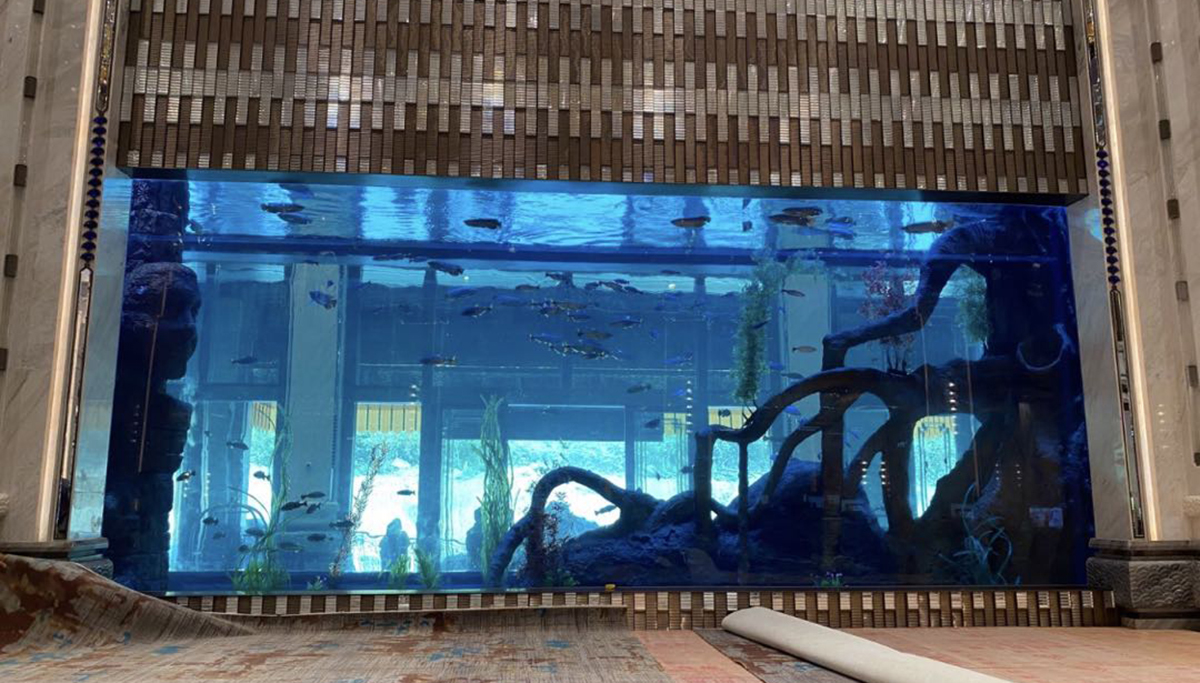
Casino aquarium, Macau — large-format acrylic viewing panel installed.
Third-party evidence for supplier review.
Manufacturing since 2006 · Exporting since 2015 · Panels supplied to 50+ countries. Material and inspection documentation is available for download to support engineering and procurement review.
The thickness usually changes once we see the drawings
Clients often send us dimensions and a thickness — and ask for a quote. We quote it. Then the CAD arrives. Sometimes the thickness needs to go up because the span is larger than assumed; sometimes it comes down because the client over-specified. Either way, the number changes.
80mm to 100mm is a common revision. It's not a big jump, but it affects lead time, weight, and what the frame needs to handle. The earlier we see the drawings, the less it costs to change.
We'd rather push back on the thickness before fabrication than explain the problem after.
The panel is usually fine. The interface is where the design breaks down.
In almost every aquarium window problem reviewed, the panel thickness was adequate. The failure — leak, delamination, or long-term seal deterioration — traced back to an interface decision that was not in the original specification.
Most common failure points
- Frame rebate not confirmed before fabricationPanel edges are machined to fit the rebate. If rebate geometry changes after panels are fabricated, either the frame is modified on site or panels are reworked. Both are avoidable.
- Compression seal not reviewed against deflectionThe seal must maintain contact at maximum panel deflection. If this is not checked during design, the seal loses contact under load and the watertight barrier fails.
- Silicone not specified for aquarium useAquarium-safe neutral-cure silicone is required. Generic construction silicone off-gasses compounds toxic to aquatic life and deteriorates faster under constant immersion.
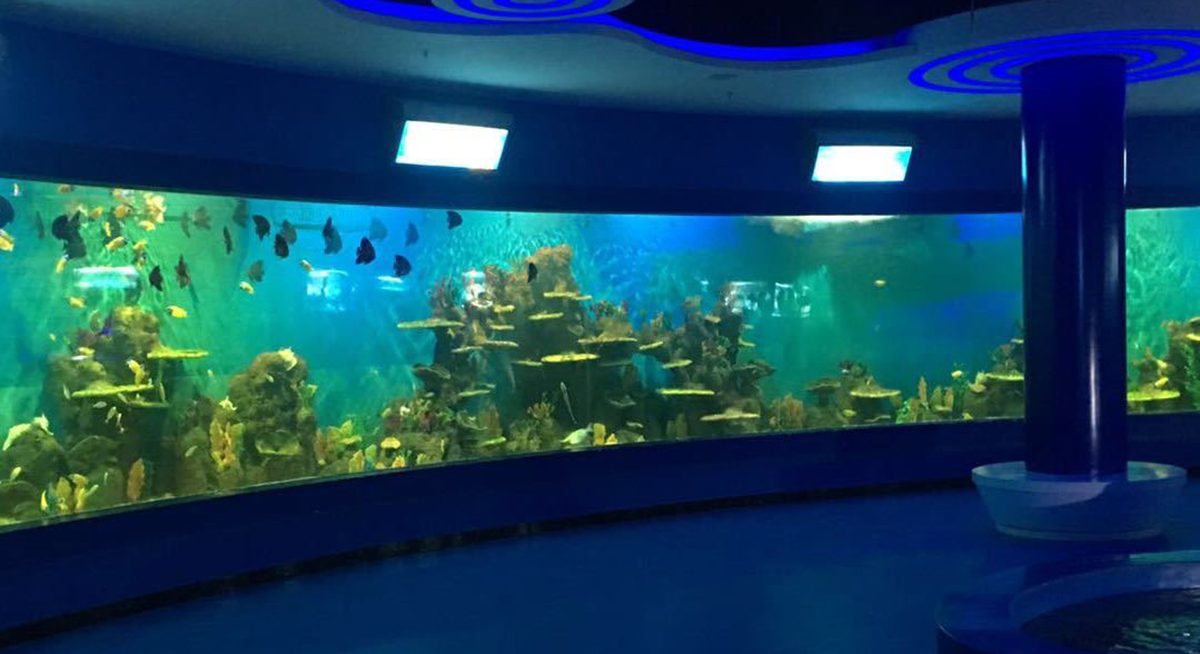
Four interface conditions that must be in the specification before fabrication.
Frame rebate geometry
- Rebate depth and width
- Panel edge clearance on all sides
- Surface finish and tolerance
- Frame material — steel, aluminium, GRC, or concrete
Compression seal
- Seal type — EPDM or neoprene strip
- Compression relative to panel deflection
- Continuity at corners
- Access for replacement over design life
Structural silicone
- Aquarium-safe, neutral-cure specification
- Joint width and depth
- Primer for acrylic and frame substrate
- Curing conditions and protection during cure
Panel edge finish
- Edge machining — flat or polished
- Chamfer at bearing edges
- Protection film removal sequence
- Handling during installation and cure
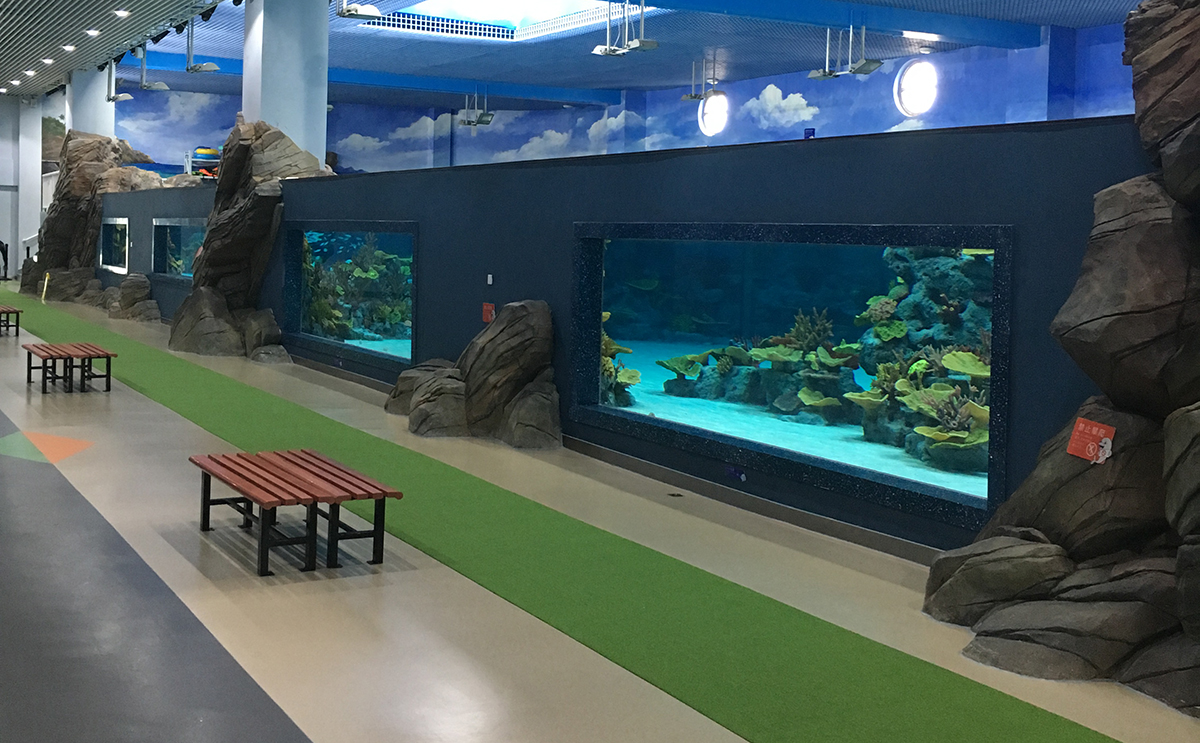
Large-format acrylic viewing panels installed — named aquarium projects are listed above.
What governs panel thickness once the interface is confirmed.
Once boundary conditions are established by the interface design, panel thickness follows from four inputs. Tank depth alone is insufficient.
| Input | What it determines |
|---|---|
| Tank depth to panel centroid | Hydrostatic pressure load — deeper tanks drive higher pressure |
| Unsupported span | Bending demand — the largest unsupported dimension between frame supports |
| Frame boundary conditions | Whether frame provides clamped or simply-supported restraint — affects effective bending span significantly |
| Safety factor | Margin against characteristic PMMA tensile strength — higher for public occupancy |
| Application | Span | Tank depth | Indicative thickness |
|---|---|---|---|
| Small commercial tank | 0.8–1.5m | 2–4m | 100–150mm |
| Mid-size public aquarium | 1.5–3.0m | 3–6m | 150–250mm |
| Large public aquarium | 3.0–5.0m | 4–8m | 220–350mm |
| Feature / large-span | 5.0m+ | 5–10m | 300–400mm |
Indicative only. Final thickness requires engineering sign-off against project-specific inputs. Do not use for procurement. For projects requiring finite-element analysis, the FEA is independently checked by Tongji Architectural Design (Group) Co., Ltd. See also: why tank depth alone is not enough →
Public aquarium applications have different requirements from private installations.
Higher safety factor. More evidence required.
- Safety factor typically 3.5–4.5 — driven by public occupancy and consequence of failure
- Material certifications typically required (tensile properties, batch traceability)
- Fabrication inspection records expected as part of handover package
- Third-party structural peer review may be required — confirm this at design stage, not after fabrication
Lower formal bar. Same interface discipline.
- Safety factor typically 3.0–4.0
- Material certifications may not be formally required — confirm with engineer of record
- Interface design discipline is identical to public applications — the consequences of an interface failure are the same regardless of occupancy type
- Delivery, handling, and installation guidance still applies in full
Aquarium viewing panel — questions that come up on every project
How thick should a public aquarium viewing panel be?
Thickness depends on tank depth, unsupported span, frame boundary conditions, and safety factor. Typical commercial panels range from 100–250mm; large public windows from 220–400mm. Correct thickness requires project-specific review — the indicative ranges above are a starting point, not a specification.
Why do aquarium viewing panels fail?
Panel thickness is typically reviewed by an engineer. The interface — frame rebate geometry, compression seal, silicone specification — is often treated as a construction detail rather than a design input. This is the gap where problems develop. The interface determines how load transfers from the panel to the structure, and whether the seal remains watertight under deflection.
Can aquarium viewing panels be bonded to make larger windows?
Yes. Large windows are often formed from multiple panels bonded using structural acrylic adhesive. Bond joint design, curing conditions, and quality assurance must be reviewed as part of the fabrication specification — not treated as a site operation after panels arrive.
What is the difference between a public and private aquarium panel?
Public aquarium applications require a higher safety factor — typically 3.5–4.5 versus 3.0–4.0 for private installations — driven by public occupancy and the consequence of failure. Material certifications, fabrication inspection records, and third-party structural peer review are typically required for public projects. Interface design discipline is identical regardless of occupancy type; the consequences of an interface failure are the same whether the tank is public or private.
When is this project ready for technical evaluation?
When the project has tank depth, opening dimensions, frame design intent, and an indication of public or private occupancy. If the frame rebate is already detailed, include it — it is the single most useful input for evaluating an aquarium panel project.
Related notes
Corner installations — where cracks usually start
Corner installations need specific treatment at the joint. This is where cracks most often start — not at the centre of the panel, but at the corner where two pieces meet. The treatment is not complicated, but it has to be done before the panel goes in, not after the water is running; most corner cracks trace back to that step being skipped.
We include corner preparation requirements in the installation guidance. It's easier to prevent than to fix.
Panel deflection, corner cracking, and installation mistakes
Most problems on pool and aquarium projects trace back to a small number of recurring mistakes — undersized thickness, corner joint preparation skipped, protective film removed too early. We've documented the ones we see most often.
Read: Common Problems — what goes wrong and whyThickness range and what we need from you.
Typical thickness range
100 – 400mm
Indicative range for typical aquarium applications, from small commercial tanks to large public windows (see thickness table above) — not the company's full cast capability. Public aquarium applications require higher safety factors than private installations.
What to send us
Tank depth and unsupported span are the two critical inputs. Frame interface and whether the installation is public or private will also affect the specification.
- Tank water depth
- Panel opening dimensions (width × height)
- Flat or curved panel requirement
- Frame rebate or channel details
- Public or private installation
- Project location
- Drawings or sketch if available
Need a quote for your aquarium project?
Share the panel size, water depth, project location and drawings you have now. PG can ask for missing details during quotation.