Thick PMMA Panels —
Cast Acrylic Manufacturing, Thickness Selection and Engineering
Structural cast acrylic (PMMA) viewing panels for large viewing openings and deeper water — supplier capability, project proof, and the methodology that sets the right thickness for each project.
PG Acrylic manufactures and supplies large structural cast acrylic (PMMA) viewing panels for pools, aquariums, underwater tunnels and oceanariums. We focus on project-based viewing panels, not retail acrylic sheets or consumer products.
Our structural cast PMMA viewing panels cover a 20–600 mm thickness range, with single panels up to 8.7 m × 3.0 m without joints. This page covers thick acrylic panel capability, large acrylic viewing panel projects, and the engineering methodology used to determine the correct thickness for each project.
Manufacturing since 2006 · TÜV / SGS / Bureau Veritas third-party reports
For a project-specific thickness review, send clear opening dimensions, water depth, support condition, whether the panel is flat or curved, and project location.
Summary for project owners: this explains factors that can contribute to yellowing or cracking — and how manufacturing and engineering controls are used to reduce those risks.
One-time cast vs. multi-layer — confirm the proposed process
Thick PMMA panels can be produced using different construction routes. In multi-layer or bonded constructions, interfaces may be difficult to see in normal conditions but can become visible under some lighting angles or service conditions. Confirm the proposed construction method during technical review.
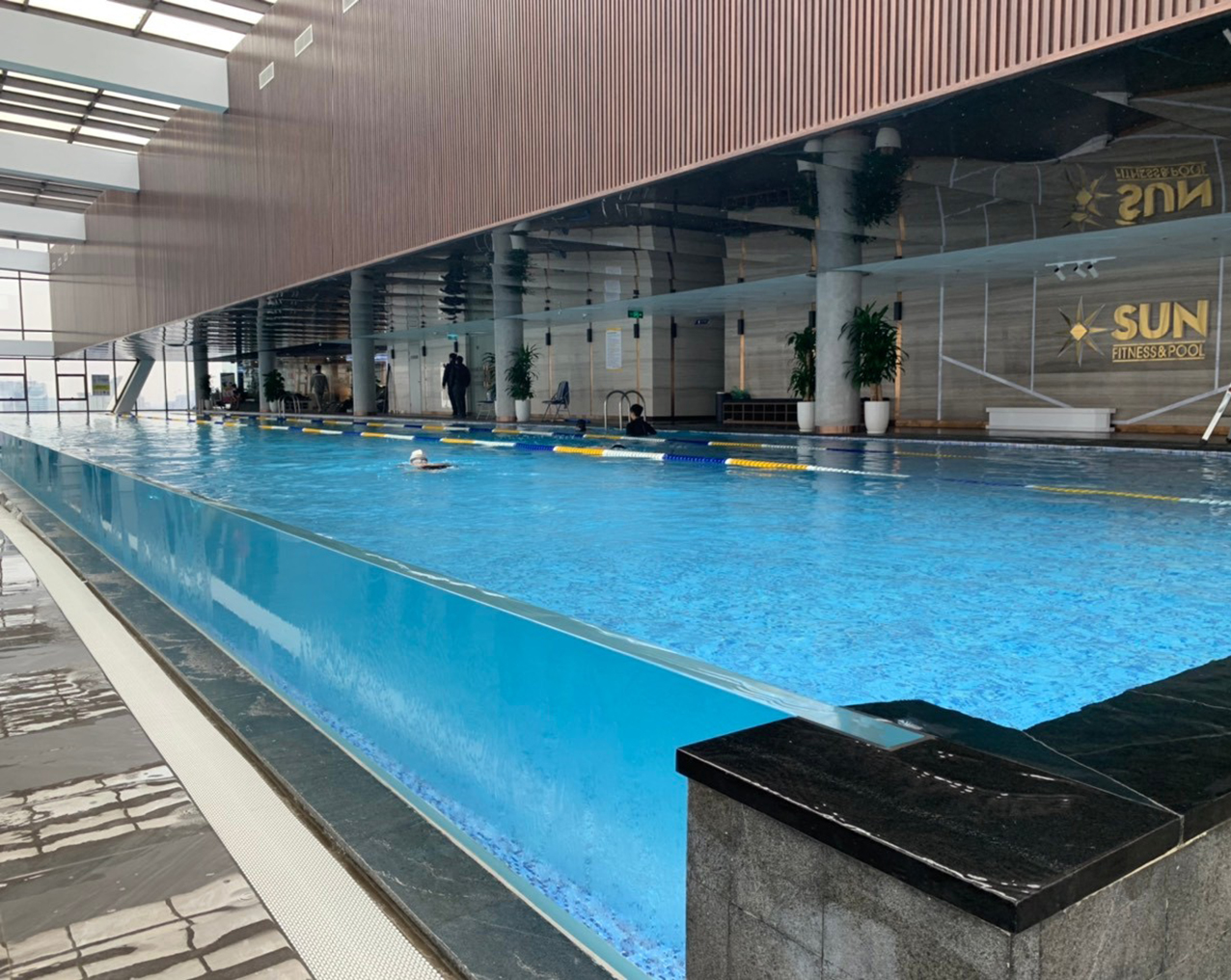
PG produces cast PMMA panels up to a maximum thickness of 600 mm. Single-cast (one-time cast) panels are formed in one piece through the full thickness — no laminated layers, no bond line through the section, and no optical interface. Where a project needs more thickness or span than a single casting allows — a project-dependent limit confirmed at engineering review — panels are joined by polymerization bonding into large continuous builds, including a 48.24 m continuous transparent pool wall system in Vietnam, polymerization-bonded on site by PG Acrylic. Cast by bulk-monomer polymerization from 100% virgin Mitsubishi Chemical MMA.
The construction method should be confirmed as part of the technical review.
Five inputs. One of them is water depth. The other four are why water depth is not enough.
Thickness is the output of structural analysis — not the input to it. These five parameters go into the analysis. Water depth is one. Unsupported span is another primary design input, and its effect must be evaluated together with water depth and the support model.
| Input | What it is | How it affects thickness | Common error |
|---|---|---|---|
| Hydrostatic pressure | Load from water depth at panel centroid (kPa) | Linear with depth — twice the depth, twice the pressure | Used alone to specify thickness |
| Visible span | Largest unsupported panel dimension between support edges | A larger unsupported span increases bending demand; the exact effect must be evaluated using the complete project model | Not stated, or confused with opening size |
| Boundary conditions | How edges are restrained — clamped or simply supported, 2 or 4 sides | Four-edge restraint can reduce required thickness relative to two-edge support; the magnitude is project-specific and must be calculated from the complete model | Assumed 4-edge simply supported when frame has only partial contact |
| Deflection limit | Maximum mid-panel movement under full hydrostatic load | Tighter limits drive thickness up independently of stress limits | Not specified — sealant fails when deflection exceeds joint capacity |
| Safety factor | Margin against characteristic PMMA tensile strength | Higher factor → thicker panel; the size of the effect must be evaluated within the complete project model | Taken from an unrelated project, or not stated at all |
Why water depth alone does not determine acrylic panel thickness →
Why span must be evaluated together with water depth.
Water depth increases hydrostatic pressure linearly. Increasing unsupported span also raises bending demand, but which input governs is project-specific and depends on geometry, aspect ratio, curvature, edge restraint, support stiffness, allowable stress and deflection, creep, temperature effects and installation tolerances.
What span-squared means in practice
A larger unsupported span generally increases structural demand — bending stress in a flat panel rises with the square of the span. But required panel thickness does not follow a fixed span-to-thickness rule. Span, water depth, panel aspect ratio, curvature, edge restraint, support stiffness, allowable stress and deflection, long-term creep, temperature effects and installation tolerances must be assessed together — the required thickness must be determined from the complete project model rather than a single span ratio.
What this means when the opening changes
When a project increases opening size from 1.2m to 2.4m, thickness does not scale with the opening. The relationship is non-linear — and the correct thickness for the new span must be recalculated, not estimated by proportion from the previous project's thickness.
How thickness ranges across all five application types.
The same methodology applies to every application. What changes is the combination of span, depth, and safety factor — not the analytical framework itself.
| Application type | Typical thickness range | Governing parameter | Application note |
|---|---|---|---|
| Pool viewing wall — residential | 80–150mm | Span + boundary conditions | Pool Viewing Wall → |
| Pool viewing wall — hotel / feature | 120–220mm | Span + interface | Pool Viewing Wall → |
| Aquarium viewing panel — commercial | 100–400mm | Span + safety factor | Aquarium Panel → |
| Underwater tunnel panel | 150–400mm | Radius + arc span | Underwater Tunnel → |
| Oceanarium panel | 250–600mm | Span + depth + safety factor | Oceanarium Panel → |
Indicative only. All values require project-specific structural analysis and engineering sign-off. Do not use for procurement.
How we determine thickness — and how it is checked.
Panel thickness is determined by structural calculation and confirmed by finite element analysis (ANSYS). It is checked against the characteristic short-term strength of cast PMMA (≈68–70 MPa) with the applicable project safety factor, with the panel analysed integrally with its supporting structure (e.g. steel frame) — not in isolation. Water depth alone is not sufficient: unsupported span and boundary conditions govern. Panel thickness is evaluated through project-specific structural FEA, with the FEA independently checked by Tongji Architectural Design (Group) Co., Ltd. Material performance is independently tested by SGS.
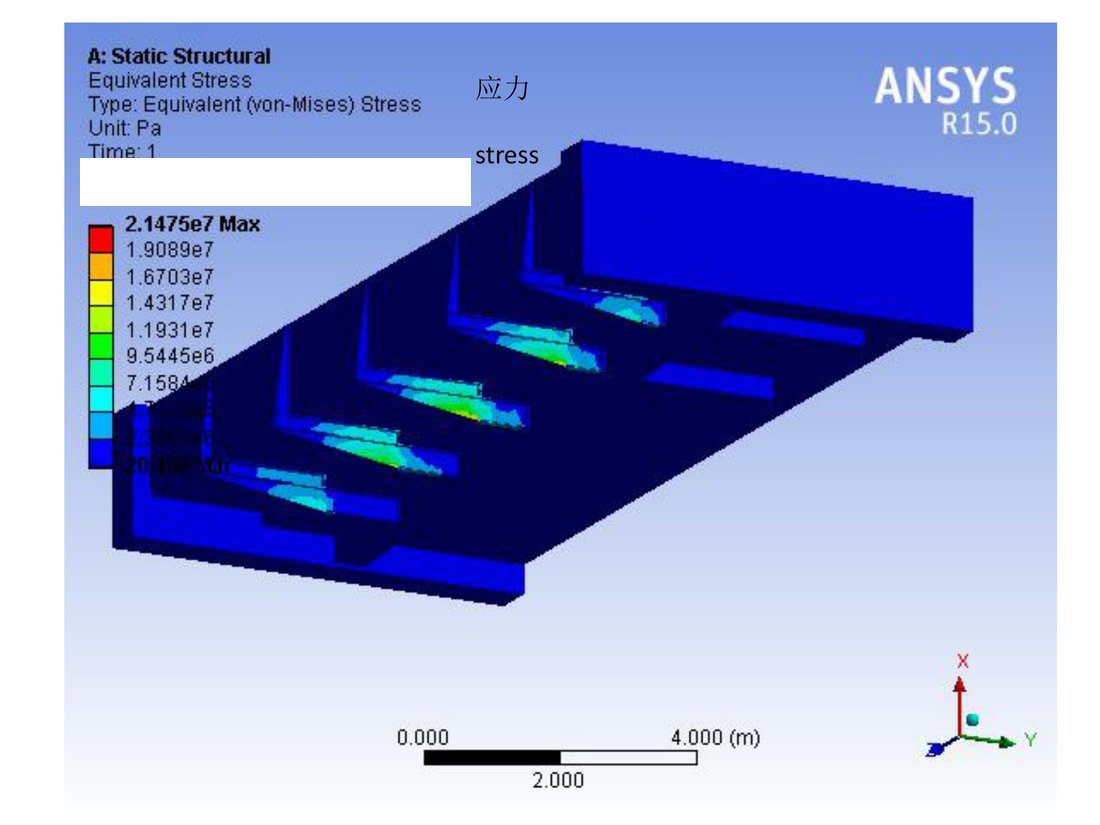
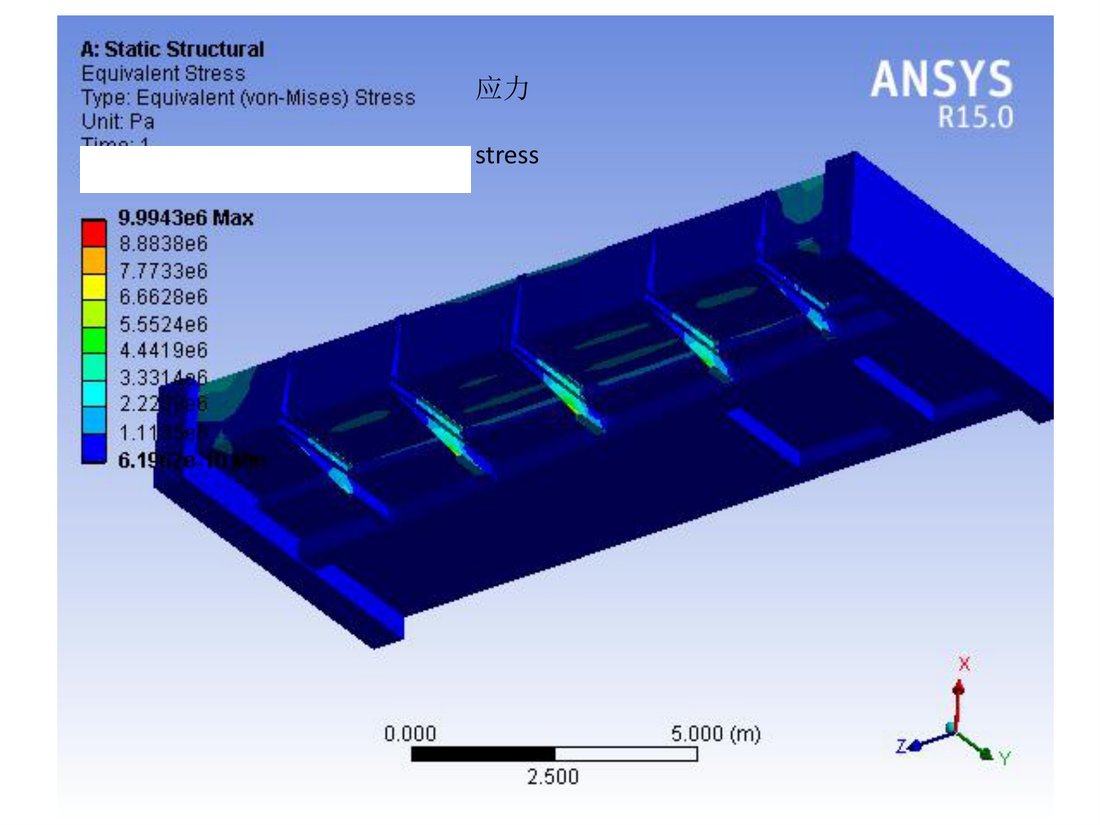
Structural FEA analysis examples (ANSYS)
The following worked example is taken from a real ANSYS finite-element analysis. Example A is a swimming-pool configuration analysis, and the results below are taken from the source ANSYS analysis report.
| Configuration | 7 acrylic panels; 5 fixed by a 4-side concrete frame (no middle beam); 2 fixed on concrete + steel structure |
| Water depth | 1.2 m (analysis run at 1.4 m head) |
| Material | Cast PMMA — short-term tensile strength ≈70 MPa used as the analysis input; the allowable design stress is set per project with the applicable safety factor |
| Result @ 150 mm | Maximum steel-frame von-Mises stress ≈22 MPa — static 1.4 m water head |
| Result @ 120 mm | Maximum steel-frame von-Mises stress ≈10 MPa under the same static 1.4 m water head |
| Outcome | 120 mm recommended in the source analysis report for this modelled configuration — meets the acrylic panel strength requirement while reducing the demand on the steel frame; consistent with general field experience (1.2 m depth → 100 mm+) |
| Analysis | ANSYS static structural analysis — integrated acrylic-panel and steel-frame model (source analysis report) |
For this modelled configuration the FEA was independently checked by Tongji Architectural Design (Group) Co., Ltd.; the source analysis report recommended 120 mm. Stress values are whole-model von-Mises maxima occurring on the supporting steel frame — not PMMA panel stress or deflection — under the stated static hydrostatic load case. They are project-specific analysis outputs for this geometry and support condition, not a general thickness recommendation or performance guarantee.
Material — independently tested by SGS
Material independently tested by SGS: total luminous transmittance 93.1% (GB/T 2410), report No. SHIN1606027157MR-01 (2016). Report verifiable via SGS's official document verification service → evidence-packs.
Engineering Boundary Constraints: the TU Delft 3 m Cylinder Aquarium
The TU Delft 3-meter cylindrical research aquarium is fully cast PMMA — including the base. The cylinder wall and the base are joined by polymerization bonding, not a mechanical or dissimilar-material joint, giving an optically continuous structure. For a structural cylinder at this scale (3 m diameter x 3 m high x 100 mm wall), thickness selection must consider visible span, ambient temperature variance, support conditions and the required project-specific deflection limit together with hydrostatic loading. Structural thickness proposals are evaluated project-specifically, with FEA used where required by the project geometry and review scope; material performance is independently tested by SGS (93.1% light transmittance on the cited test specimen).
What thick cast PMMA panels actually require to produce.
Panels above 100mm are not cut from sheet stock. They are cell-cast in purpose-built moulds. The casting and annealing process imposes constraints that affect maximum dimensions, lead time, and residual stress — and these must be factored into design from the start, not discovered during procurement.
Casting cycle duration
- Panels above 150mm require extended casting cycles — days, not hours
- Above 300mm, cycle time extends significantly and temperature control becomes critical to avoid internal stress
- Casting cycle directly affects lead time from order to delivery
Annealing — not optional
- All thick cast PMMA panels must be annealed to relieve residual thermal stress from casting
- Annealing cycle duration increases with thickness
- Inadequate annealing produces residual stress that causes crazing in service — often not visible until the panel is under hydrostatic load
Maximum plan dimensions
- Maximum plan dimensions depend on casting facility and panel thickness
- Thicker panels are available in smaller maximum plan sizes — mould and oven dimensions are the limiting factors
- Very large panels may require bonded multi-piece construction regardless of thickness
Thickness accuracy in thick cast acrylic: how PG controls it
Cast PMMA naturally varies slightly in thickness across a large panel — this is inherent to the casting process. To guarantee the specified minimum, PG Acrylic produces to a positive tolerance: panels are cast from a mould set slightly above nominal (the positive tolerance varies with panel thickness). Panels running thick are polished down to the final dimension, and final thickness is confirmed by direct measurement — the most verifiable form of QC. Material performance is independently tested by SGS (93.1% light transmittance).
For structural viewing applications, the material specification is not optional.
Cast and extruded PMMA are both called acrylic. For panels above approximately 25mm in a structural viewing application, they are not interchangeable — and specifying the wrong one is not a substitution that can be corrected after fabrication. Structural acrylic panels use cast (cell-cast) PMMA; extruded is a thin standard-sheet product not used for thick structural panels. Specify cell-cast PMMA, annealed, to the thickness and plan dimensions required by structural calculation.
Thickness selection — questions that come up on every project
How is the correct thickness selected for a structural PMMA panel?
Structural analysis considering hydrostatic pressure, visible span, boundary conditions, allowable deflection, and safety factor applied to characteristic PMMA tensile strength. Water depth alone is not sufficient. The analysis must be project-specific — scaling from a previous project is only valid if span, boundary conditions, and safety factor are identical.
Why can span be as important as or more important than water depth?
Water depth increases hydrostatic pressure, while increasing unsupported span raises bending demand. Which input governs depends on the complete project model, including geometry, aspect ratio, curvature, support stiffness, boundary conditions, allowable stress and deflection, creep, temperature effects and installation tolerances. Thickness should not be selected from water depth alone.
What safety factor is used for cast PMMA viewing panels?
Safety factors are project-specific and must be defined within the applicable design basis and load model — considering the applicable standards, material data, load combinations, long-term creep, support assumptions, temperature effects and installation tolerances. The project specification should state the design basis and factor explicitly.
What is the maximum thickness for cast PMMA acrylic panels?
PG Acrylic manufactures cast PMMA viewing panels from 20 mm up to 600 mm thick. Whether a given panel is produced as a single casting or as a polymerization-bonded build is a project-dependent manufacturing decision — it depends on thickness, plan dimensions and the casting facility, and is confirmed at engineering review. As thickness increases, casting and annealing cycles become longer and are confirmed during manufacturing review.
What is the difference between cast and extruded PMMA for structural viewing panels?
PG Acrylic uses cast (cell-cast) PMMA for thick structural viewing panels. Cast and extruded PMMA have different molecular-weight profiles, forming behavior and available thickness ranges; PG's thick viewing panels and polymerization-bonded assemblies use cast PMMA. Extruded PMMA is not part of PG's thick structural viewing-panel process.
Can the thickness from a previous project be reused?
Only if span, boundary conditions, and safety factor are identical. If any of these has changed — and even a small change in span has a significant effect on required thickness — the previous project's thickness cannot be scaled directly. A new calculation is required.
How is PG's thickness analysis carried out and checked?
Panel-and-structure models are analysed by finite element analysis (ANSYS) as integrated panel-and-support models. A 1.2 m-depth swimming-pool configuration analysis resolved at 120 mm is shown above, taken from the source ANSYS analysis report, with material properties independently tested by SGS.
How is the wall thickness of a large cylindrical acrylic aquarium determined?
It is governed by visible span, boundary/support conditions, ambient temperature variance and a project-specific deflection limit — not water depth alone. On the TU Delft 3 m research cylinder (3 m dia x 3 m high x 100 mm, fully cast PMMA with the base polymerization-bonded to the wall), thickness was set against project-specific FEA, with SGS-tested material (93.1% light transmittance).
How does PG Acrylic ensure thickness accuracy in thick cast acrylic panels?
Cast PMMA naturally varies slightly in thickness, so PG produces to a positive tolerance — casting from a mould set slightly above nominal, then polishing panels that run thick down to final dimension, with thickness confirmed by direct measurement. Material is SGS-tested at 93.1% light transmittance on the test specimen.
Does PG Acrylic's structural analysis account for seismic or other extreme load cases?
Yes, to the extent a project requires. PG Acrylic's finite element analysis is driven by the project geometry from the CAD and drawings, with hydrostatic water load as the primary case. Where the project or local code calls for it, additional load cases such as seismic and thermal effects are included in the analysis.
Does ASME PVHO-1 apply to aquarium, oceanarium or pool viewing panels?
ASME PVHO-1 is the safety standard for Pressure Vessels for Human Occupancy — vessels where people are inside under a pressure differential (submersibles, hyperbaric chambers, certain pressurised viewports). Most aquarium, oceanarium and pool viewing panels are not PVHO vessels: people stand on the dry side at atmospheric pressure with water on the other. PG Acrylic does not claim PVHO-1 certification; instead, panel thickness is determined by project-specific finite element analysis against the characteristic strength of cast PMMA with an appropriate project-specific safety factor. Where a project genuinely involves human occupancy under pressure, PVHO-1 requirements should be confirmed with the project's structural engineer.
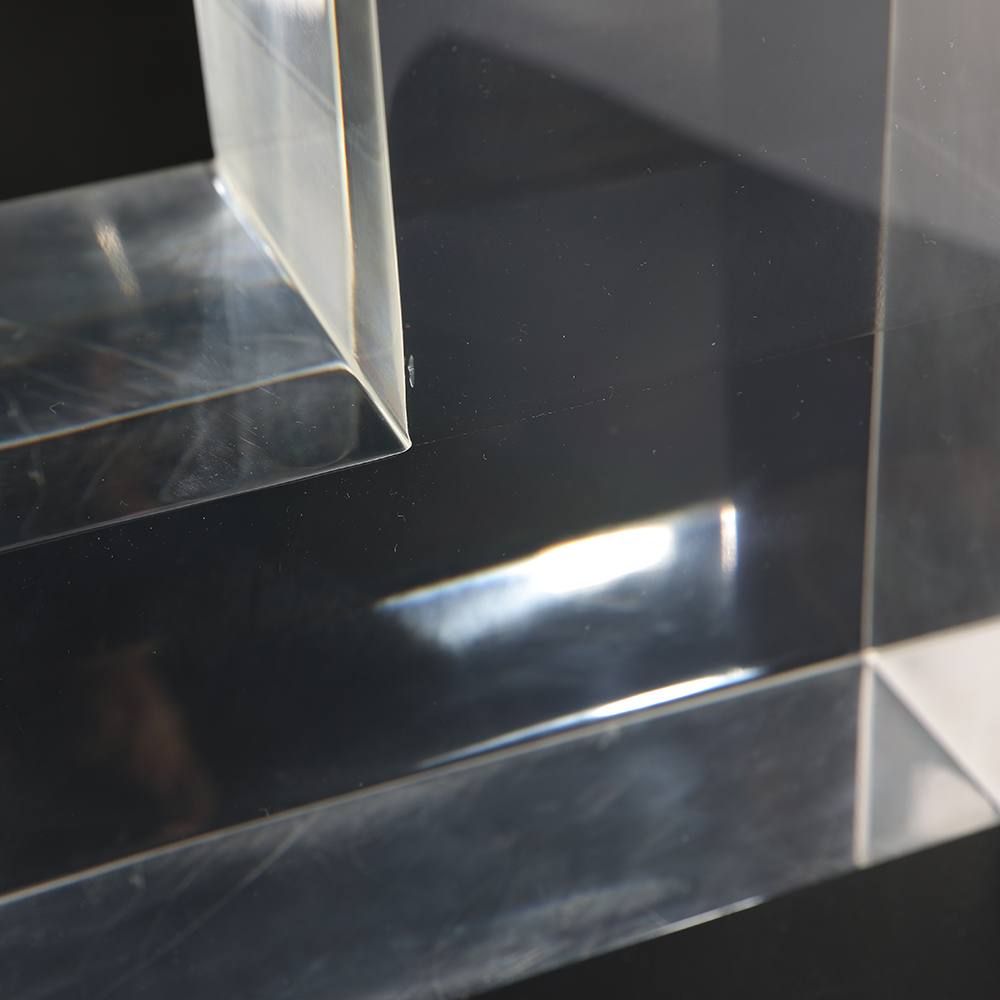
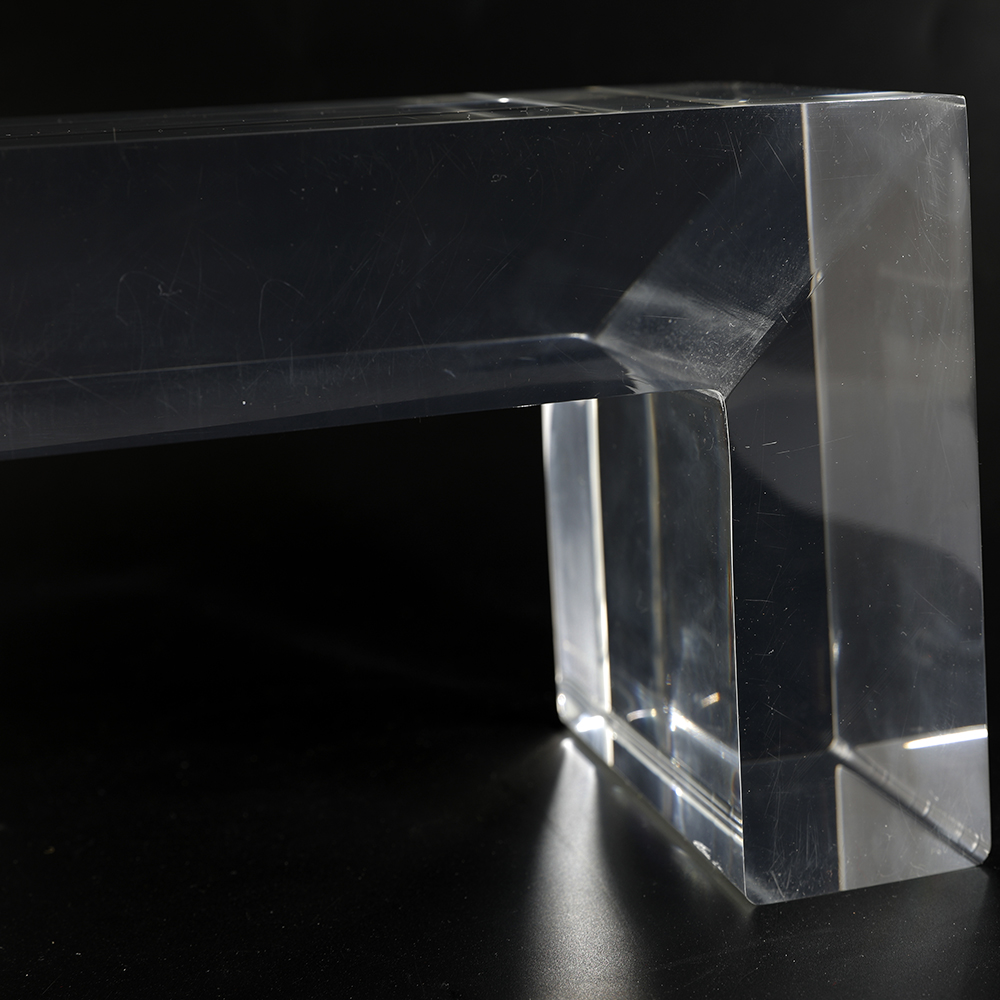
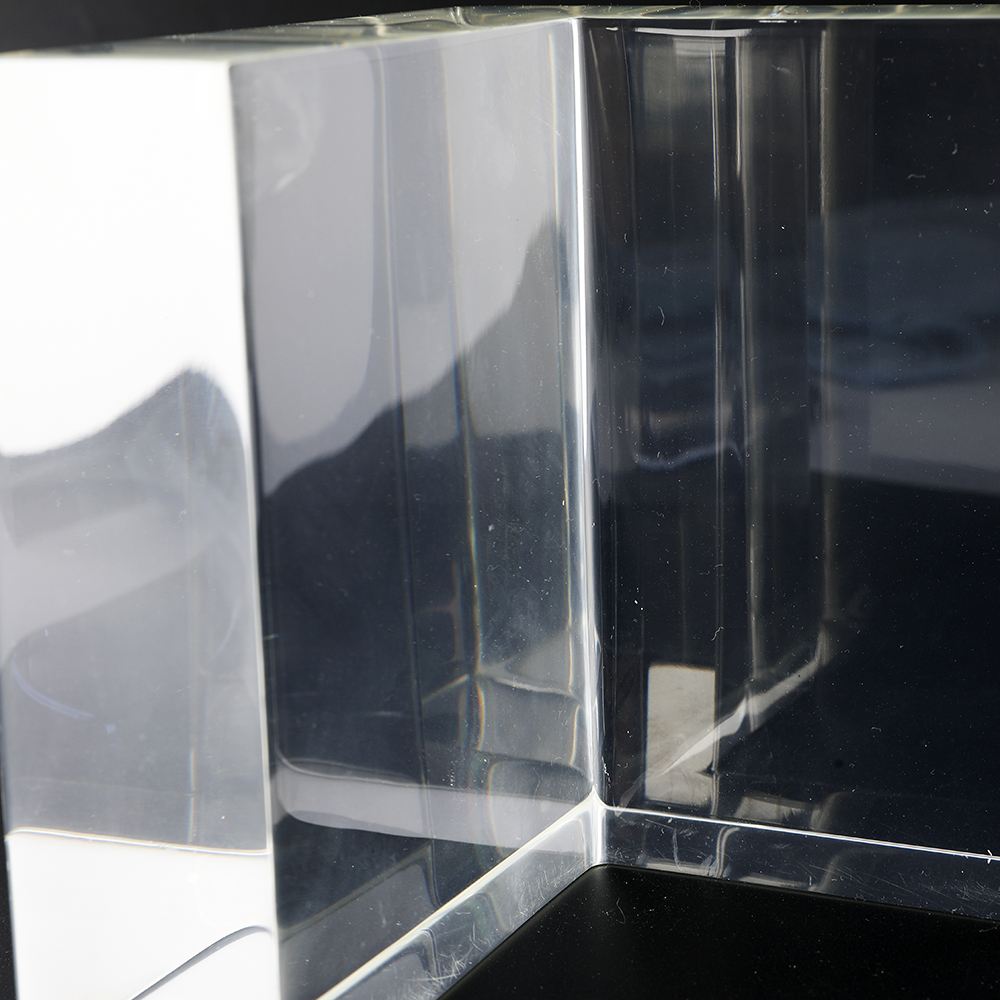
What thick cast PMMA looks like — and what it tells you about the specification.
The physical properties of correctly cast and machined thick PMMA are visible at the edge and corner. Optical clarity through section, machined face flatness, and corner geometry all reflect the casting and annealing process — and are the first thing a structural reviewer will ask about.
Material documentation — available for download.
The thickness calculation tells you the number. These documents tell you the material that number was calculated for. Both are required before procurement.
Related application notes
Thickness range and what we need from you.
Cast manufacturing capability
20 – 600mm
Full cast thickness capability. Typical ranges by application are shown in the table above; casting schedule and dimensional limits are reviewed at order confirmation. Final thickness requires project-specific structural analysis.
What to send us
Thick panel specifications require all five inputs: application type, water depth, unsupported span, boundary conditions, and safety factor. Water depth alone is not enough.
- Application type (pool, aquarium, tunnel, oceanarium)
- Water depth
- Unsupported span / clear opening dimensions
- Boundary conditions (support on how many sides)
- Flat or curved panel shape
- Safety factor requirement if specified
- Project location
- Drawings or specifications if available
Have a thick PMMA panel project?
Send us your dimensions, water depth, and installation type. We'll confirm whether the thickness works, what's missing, and what needs to be resolved before fabrication.